

Singapore is seeking answers. The country is engaging local businesses over tighter US restrictions on advanced Nvidia chips.
The move follows reports of a possible halt in server shipments. Four Southeast Asian countries are said to be affected. The government has not confirmed the reported suspension. It is also working with Washington to protect access to advanced technology.
Singapore Engages Local Businesses
Deputy Prime Minister Gan Kim Yong said on Friday, November 27, that the government was assessing the impact of the new rules.
"We are in the process of engaging our businesses, to reach out to them to see how this impacts their businesses," he said at a local summit.
He added that companies were seeking alternative partnerships to maintain access to the technology. Gan said Singapore would continue working with the United States. The aim, he said, was to ensure local firms could still obtain high-end chips.
"Many of the operators, hyperscalers in Singapore, are also Americans, and many companies are operating here," he said.
He also stressed that continued US support was important to the region's technology services and customers.
US Tightens Chip Export Rules
The restrictions took effect on November 19. They require export licences for advanced chips sent to Singapore, Malaysia, Thailand, Indonesia and Brazil.
The rules were introduced by the US Department of Commerce. They are intended to prevent advanced computing technology from reaching Chinese companies through third countries.
Data centres serving Chinese businesses are also facing tighter scrutiny. The rules require additional checks on who accesses their computing capacity.
Nvidia Shipment Halt Reported
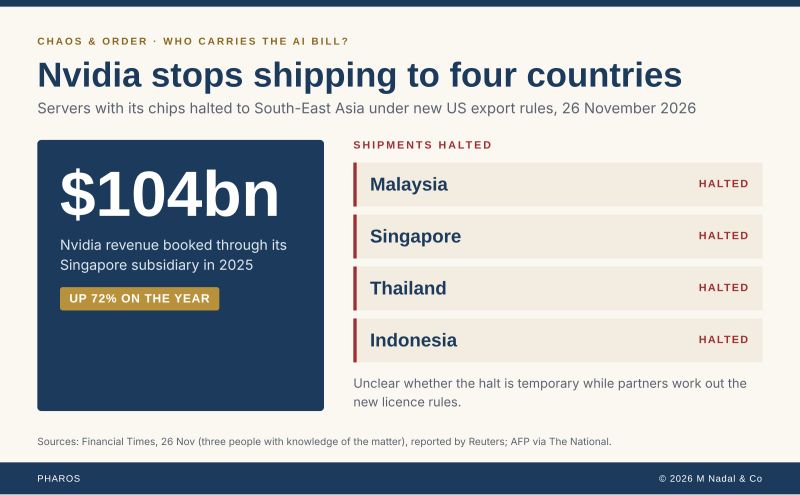 Reports indicate Nvidia has paused server shipments to Singapore, Malaysia, Thailand and Indonesia amid tighter US chip restrictions.
The move could threaten data centre investments across Southeast Asia.
The Financial Times reported on November 26 that Nvidia had instructed manufacturing partners to pause server shipments to four Southeast Asian countries.
The affected markets were Singapore, Malaysia, Thailand and Indonesia. Dell and Supermicro were among the companies reportedly involved.
The duration of the pause remained unclear. It was also uncertain whether shipments would resume once the new licensing requirements had been addressed. Nvidia had not immediately responded to requests for comment, according to Reuters.
Data Centre Investment at Risk
The restrictions could also affect investment across the region. Southeast Asia has attracted major technology companies seeking to expand their data centre operations.
Fitch Ratings warned that investment in Asia-Pacific data centres could slow. Projects are also expected to face closer scrutiny as access to advanced chips becomes more difficult.
The pressure could force governments to balance two priorities: maintaining access to US technology while attracting investment from Chinese firms. For Singapore, the challenge will be to protect its position as a regional technology hub while complying with Washington's new rules.